September
16, 2021 (published)
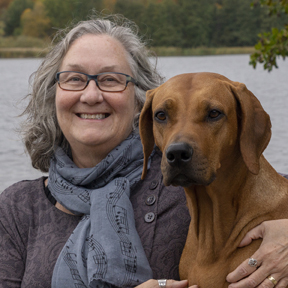
Photo
courtesy of Dr. Brenda Bonnett
Dr.
Brenda Bonnett, shown with Smilla, advocates educating pet owners
to value health over looks when choosing their animal companions.
As
chief executive of the International Partnership for Dogs, an
organization with a mission to enhance canine health and welfare, I
read with interest the article "Calls
for bans on breeding short-nosed dogs gain momentum"
published last month by the VIN News Service. The IPFD has
been creating
resources on
the brachycephalic issue for many years, on many fronts.
I
recognize that the article was intended to have a limited scope, but
my concern is that we are missing the big picture. To see it, we
need to consider the bonds between millions of "brachys"
and their owners, the influence of the pet industry promoting these
dogs, how veterinarians have played a role in normalizing them, and
the consequences of banning these breeds, if that were even possible.
Advocates
of breed bans, which are mainly an emotional response, seek a simple
solution to a very complex problem. Many stakeholders have
responsibilities on both sides of this question, and narrow fixes are
not going to work without severe unintended consequences, such
as angering owners and eliminating responsible breeders.
I
absolutely agree with Dr. Emma Goodman Milne, founder of Vets
Against Brachycephalism,
that "we need veterinarians to stand up and say, 'These animals
are suffering.' " But how is change, practically, accomplished?
The
ethical challenges, conflicts of interest and responsibility of
veterinarians to these dogs should be
clear to
all. However, in discussion with veterinarians on the front line, I
hear their concerns: How
do you approach this problem when up to half the dogs you see (the
estimate of one British veterinarian) are brachys — and when owners
are so attached?
History
The
trend toward extremes in conformation, or body shape and structure,
started in the Victorian era, and concerns
were raised by welfare advocates about brachycephalics — especially
bulldogs — in the early 1900s. Fast forward to the 1960s, and
veterinarians were raising the alarm about BOAS — Brachycephalic
Obstructive Airway Syndrome, a
condition that
causes breathing problems due to disproportionate facial features.
It
also was recognized decades ago that problems in brachycephalic
breeds encompassed much more than breathing, given that their
conformation affected their spines, digestive tracts and other parts
of their anatomy. However, veterinary groups focused more on
other issues of extreme conformation, such as hip dysplasia, that
affected the popular breeds of the day (German shepherds, Labrador
retrievers) because the brachys were relatively uncommon. Leap to the
2000s, and it is a whole new world./.../
Perhaps
we have been taken aback by the sheer force of popularity of
short-muzzles — and we blame that on celebrities and media. But we
know now, thanks to research,
that it is mainly based on the
increased desire for small, extreme dogs that are perceived by their
owners as cute or "funny" and having other desirable
characteristics, such as a supposed low need for exercise.
/.../How
do we deal with a crisis that involves intense human influences, a
massive number of dogs and disagreements between veterinarians and
other stakeholders about potential solutions? Members of the
profession often have promoted and supported the popularity of these
dogs by treating their problems as normal, posting pictures of
"funny" brachys on social media, not participating in
a registry
of conformation-altering surgery and
providing reproductive services to compromised dogs.
Major
veterinary organizations have come out with broad-based proclamations
but given the clear lack of success, what more could have been and
should be done?
A
new book edited by Rowena Packer and Dan O'Neill, Health
and Welfare of Brachycephalic (Flat-faced) Companion Animals,
(in which I co-wrote the ninth chapter on international aspects),
asserts in chapter four that veterinarians' making money off these
dogs — a clear conflict of interest — impinges on their attention
to welfare. Owner attachment and desire also often seem to take
precedence over what might be best for the dog.
The
book outlines communication strategies that can be used to approach
this touchy situation. But veterinarians in practice, especially
under conditions of the pandemic, are stretched thin. They may not
have time for nuanced conversations. Moreover, the many veterinarians
working in corporate practices may have limited authority over such
decisions.
In
a nutshell, we have a lot of clients with compromised dogs who do not
want to hear about it. Veterinarians normalize problems because they
don't want to be confrontational and are pressed for time. So,
cognitive dissonance is a problem. Veterinarians may treat the
patient in front of them and hope someone else will fix the wider
problem.
Veterinarians
have called on breeders to change their standards and stop creating
compromised dogs. Fair enough. But what about the majority of dogs
sourced from breeders who are not under the jurisdiction of kennel
and breed clubs? Most legislation is aimed at the pedigreed-dog
world, even if a lot of the problem comes from outside. Breeders
of purebred animals and their organizations are mixed in their
responses, with some clubs taking major steps. But anger, denial and
them-versus-us attitudes are prevalent.
Future
What
is the future for which we are laying the groundwork? Will we hope
that brachy popularity wanes and the issue cools down? Can we be sure
that without a basic change in attitudes, toward valuing health over
appearance, that the dog-loving public won't choose some other,
possibly worse, extreme dogs to be their darlings? Will our
colleagues survive the challenges of compromised dogs, the pandemic
and the realities of practice today?
What
we can be sure of is that a better future for dogs — and
veterinarians — requires a coordinated, multi-stakeholder
responsibility for recognizing and addressing the problem. Isolated
actions have not been overly successful in the past and are unlikely
to work in the future. Breed bans and unilateral legislative actions
are likely to be unenforceable, at best. Kennel club breeders should
step up and make the effort to improve their breeds. But expecting
them to solve the problems at a societal level is unrealistic. If
people want these types of dogs, demand will support the supply, from
whatever sources can be found.
Change
even one viewpoint
What
can an individual veterinarian do? Affirm your ethical principles and
examine your behavior. If there is a disconnect, identify small steps
to move in the right direction. That could involve no longer
normalizing problems. Owners could be told, kindly and
compassionately, that while certain health issues may be typical in
the breed, they are not normal for dogs.
In
addition, you could perhaps try
to get people whose dogs require surgical altering, such as for
narrow nasal passages and elongated palates, to spay or neuter their
dogs.
If the veterinary body or kennel club in your area has a registry for
surgeries, such as that offered
by the Kennel Club in
the United Kingdom, contribute to it. Do
not assist compromised dogs to breed and do not engage in (multiple)
elective surgeries for births.
Talk to your clients. Talk to veterinarians and techs who own these
dogs. Find out their ethical standpoints and try to move them ahead,
one step at a time./.../
Conclusion
In
the aforementioned book on brachycephalic dogs, the editors question
whether it is an "innate human flaw" to prioritize our own
pleasure in loving these dogs above the lifetimes of suffering they
may endure. Brachycephalic health problems are not truly an animal
issue, but a human issue that affects animals. Consequently, human
behavior change is the only effective solution. That begs the
question: Can hearts and minds be changed?
Please
know that I am trying to describe the situation without being
judgmental. This is an emotionally charged issue from many angles for
many different stakeholders. The scientific literature has documented
the complexity of people's relations with brachycephalics, and the
role these dogs serve in their lives. There is a lot of human
psychology at play here, including of owners attracted to flat-faced
animals, and breeders attached to the status quo. Removing the
worst breeds doesn't change human behavior. If we do not educate
people to want healthy dogs (and agree on what constitutes a healthy
dog with adequate welfare), we may have to keep dealing with extreme
breeds, as people feed their desires for "special" pets.
Hela detta långa inlägg läser jag som en balanserad, insiktsfull redogörelse för hur hundars liv kan se ut, när människors längtan efter något speciellt, något älskansvärt och samtidigt bekvämt får styra. Och, förstås, när producenternas längtan efter fortsatta försäljningsframgångar går åt samma håll. Som Brenda Bonnett säger, finns inga enkla lösningar; ett rasförbud lär bli svårt att genomdriva. Men en tanke som slår mig är, att när extremtrubbnosarnas popularitet börjar dala, när veterinärkostnaderna och försäkringspremierna blir alltför höga i relation till bostadslån och elpriser, och efterfrågan faller - då, om inte förr, kliver lagstiftarna in. Vi har nog inte sett det sista domstolsärendet.
Men var det verkligen det här inlägget, som gjorde svenska trubbnosuppfödare så arga att de ville få tyst på Brenda Bonnett?
Bodil Carlsson